

COLOURS OF THE BAYEUX TAPESTRY
COLOURS OF THE BAYEUX TAPESTRY
With the Bayeux Tapestry due to return to the UK in the autumn, for the first time in 900 years, I thought it would be interesting to look at how this impressive work of art is still visible to us today, nearly a thousand years after its creation. It is the only surviving example of medieval narrative needlework and tells the story of the battle between King Harold II of England and William, Duke of Normandy, who took the English crown at the Battle of Hastings in 1066.

Although referred to as a 'tapestry' it is more correctly a work of embroidery, made of stitching on cloth rather than weaving. Anglo-Saxon needlework was famous throughout Europe and the tapestry is thought to have been commissioned around 1070 by Bishop Odo of Bayeux, half brother of William the Conqueror, and produced by skilled embroiderers working in and around Canterbury.
Given its turbulent history it's surprising the tapestry still exists at all. It survived the sacking of Bayeux by the Huguenots in 1562 and use as military wagon covers during the French Revolution of 1792. Towards the end of World War II the Gestapo took it to the Louvre with plans to move it on to Berlin, but the end of the war saw its return to Bayeux where for many years it remained safely stored away from the light.
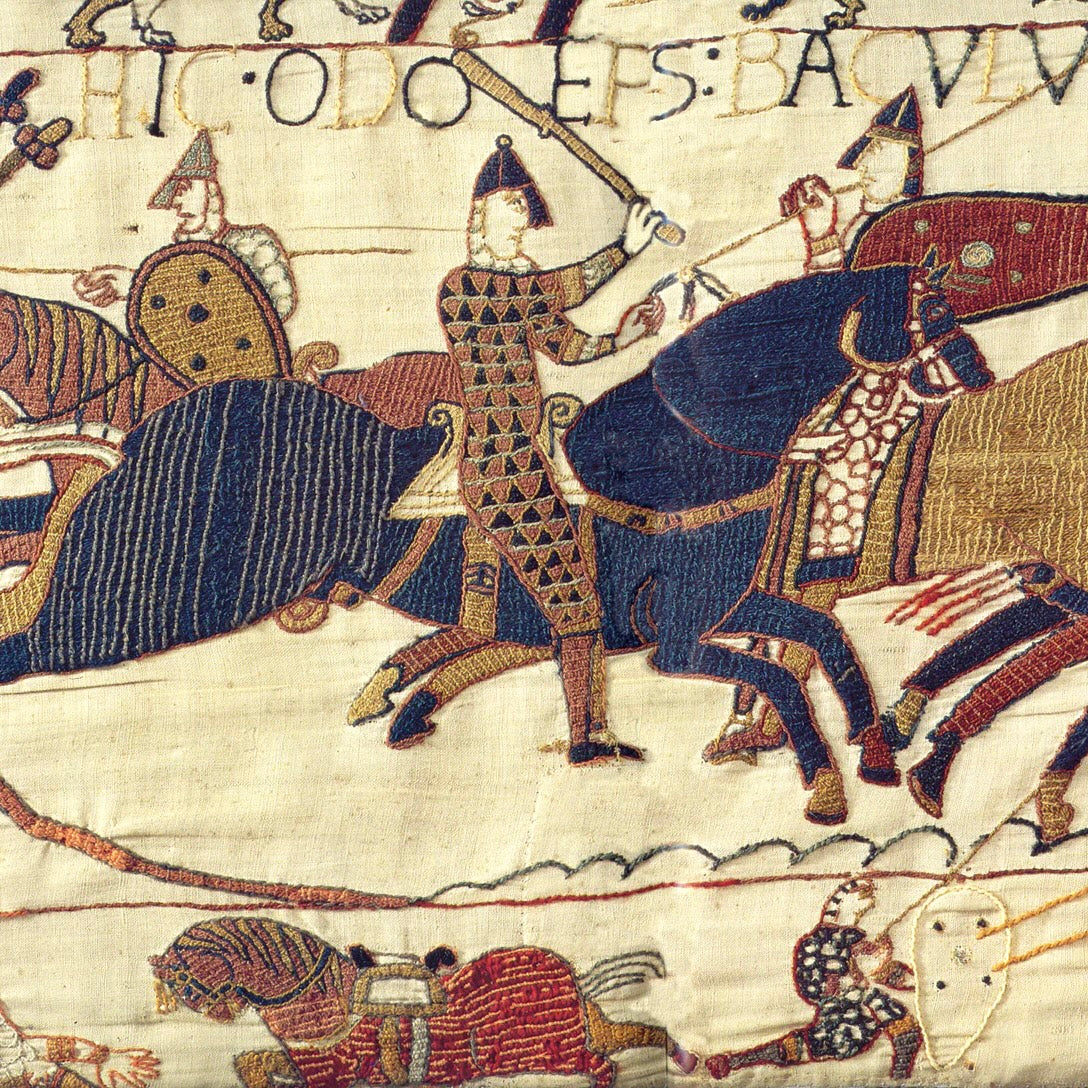
The Bayeux Tapestry is an extraordinary piece of work almost 70 metres long. In a simplified and highly stylized form, instantly recognizable to most school children, it depicts hundreds of characters including the main players of the story alongside the soldiers, craftsmen and laborers. There are even more animals including horses, dogs, birds and fish, all created using woollen thread on a linen background.

Through the use of various spectroscopic methods, scientists have identified that the yarns were dyed using the most colourfast natural plant dyes available in Europe at the time: MADDER for reds, WELD for yellows and WOAD for blues. Dyeing first with woad and then overdying with weld produced greens, and madder and weld combinations produced orange shades. The darker browns and black were created using tannin rich material such as oak gall with iron and various shades of natural, undyed wools provided whites and light browns.
Wool, due to its unique structure with an inner cortex protected by outer scales, holds dye exceptionally well. Though inevitably faded the colours still sing and the tapestry provides a fascinating historical record of a momentous political event, its players, their dress, hair styles, implements and so much more.

And these same dye plants still provide the core palette for today's natural dyers:
MADDER Rubia tinctorum - a member of the coffee family madder is a native of Europe and the Mediterranean. It produces small yellow flowers followed by dark berries, but it is for its roots that madder has long been famous, growing to over a metre in length and a centimetre thick. These contain a complex range of dyes imparting a brick-red colour to fibres and, through a lengthy and complex process the red element, alizarin, can be coaxed into producing the much brighter 'Turkey' red.
WELD Reseda luteola - also known as dyer's rocket, is rich in luteolin which produces a bright yellow dye. A native of Eurasia it has been known to dyers for a least two thousand years. It can be spotted in flower in July when it reaches 1.5 metres in height but it does not compete well with other plants so is most like to be found on recently disturbed ground such as building sites. The whole plant except the roots can be foraged for dyeing.
WOAD Isatis tinctoria - is a member for the Brassicaceae mustard family and thrives in temperate climates. Woad has been cultivated in Britain since the Iron Age and until Indigo became available in Europe with the development of trade routes in the 15th century, it was a major agricultural industry. The outer leaves should be picked in the first year of the plant while it is still a low-growing rosette.
Many natural dyers now turn to INDIGO Indigofera tinctoria, belonging to the Fabaceae legume family, as it contains the same blue dye compound as woad (indigotin) but in much higher concentrations. However, it grows best in a tropical climate so has to be imported. Like woad it is not soluble in water and has to be processed as a 'vat' dye. See our blog INDIGO - KING OF DYES
The Bayeux Tapestry is due to be on loan to the British Museum from September 2026 to July 2027 giving those within reach of London a chance to see this remarkable artwork first hand, in all its colourful glory.