
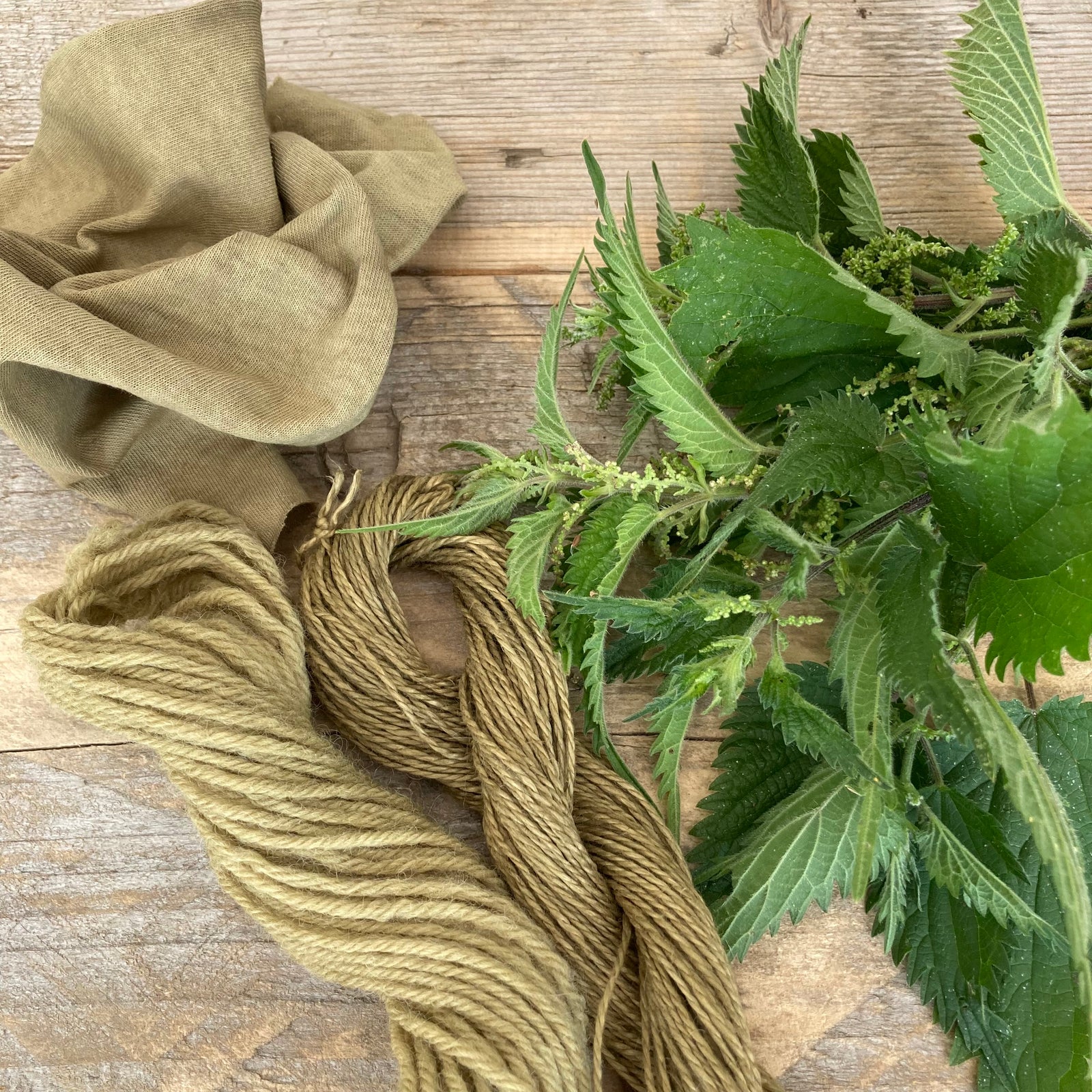

NATURAL DYEING WITH STINGING NETTLES (Urtica dioica)

Most people are only too aware of the perennial nettle, Urtica dioica, because of its sting and in fact the word ‘urtica’ derives from the latin ‘uro’, meaning to burn. It’s cousin, Urtica urens, is a smaller, less common annual nettle but also with the sharp stinging hairs, tipped with silicon, that deliver the chemical assault.
A member of the Urticaceae family with over 500 species worldwide, it thrives in hedgerows, woodlands and gardens where it favours damp rich soil and is closely associated with sites of human habitation where the ground has been disturbed.
Not to be confused with the non-stinging Lamium species of ‘dead nettle,’ which can be identified by the white, or yellow or purple hooded flowers, the common stinging nettle is widespread throughout the British Isles and can grow to well over a metre in height. It’s an important plant for many insects, being the laval food source for several species of moth, and of butterflies such as the peacock, comma and small tortoiseshell.
But stinging nettles also have health benefits that have been harnessed for hundreds of years both as a nutritional green vegetable and as a medicinal herb. Nettles can be found cited as a treatment for everything from pneumonia to dog-bites. The Ancient Egyptians used a nettle infusion to relieve arthritis and back pain and Nicholas Culpepper, the famous 17thC herbalist, recommended a concoction of nettles and honey to relieve sore throats. A bucketful of nettles steeped in rainwater for a month makes an excellent liquid fertilizer.
Related to flax and hemp, nettles contain a bast fibre which is produced using the same retting system as linen. The use of the long nettle stem to make a tough fibre for clothing and cordage dates back over 2000 years to the Bronze Age, with evidence of its use to be found on sites around the world. The word nettle can be traced back to the Old English word ‘noedl’, meaning needle.
Over time nettle fibre was replaced by cotton, but with growing environmental concerns it is again in demand as a more sustainable option, its production requiring less water and fewer pesticides. Anyone who made it to the Fibre Quest gathering in March, at Fernhill Farm in Somerset, would have had the opportunity to see the nettle fibre process first hand at a fascinating workshop run by Brigitte of BeeKay Makes.
My interest in nettles is, of course, as a dye plant and I was interested to learn that during World War II children were encouraged to collect nettles for the production of a dark green dye for camouflage material.
Never having dyed with nettles myself, I was keen to go give them a go.

(Nettles growing in the hedgerow)
You can forage for nettles throughout the summer, but it’s preferable to gather them in the spring when they are still fresh and bright green. These nettles were gathered in early June when some were beginning to flower.

(Foraged nettles in basket)
Be sure to leave any foraged dyestuffs outside for a couple of hours to give insect life a chance to go elsewhere.
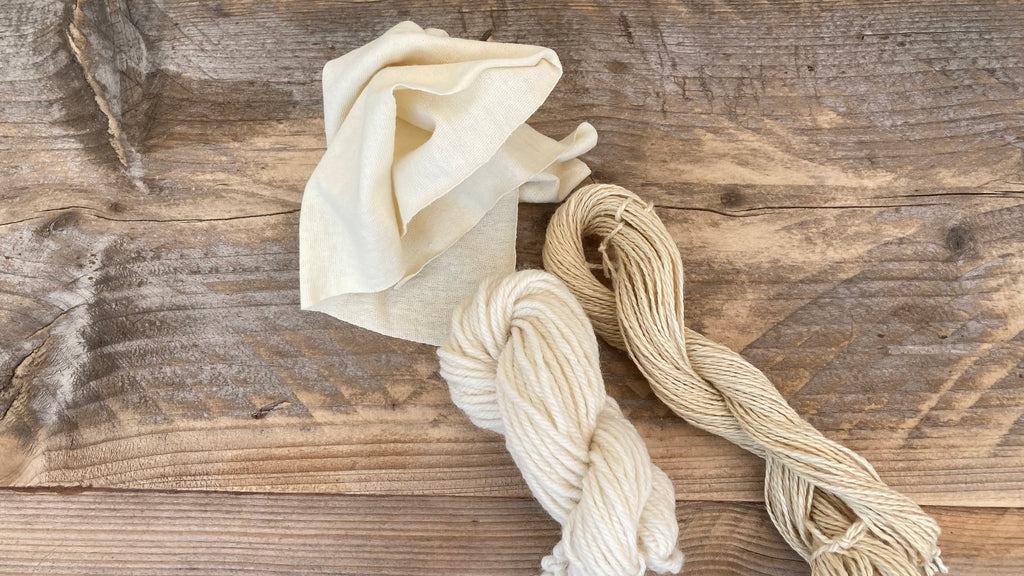 (Un-dyed yarns)
- For this dyeing session I used two plant fibres; a piece of cotton fabric and a skein of linen yarn.
- I also used a skein of wool, an animal fibre.
- I always dye plant (cellulose) fibres and animal (protein) fibres separately as animal fibres are more fragile and need gentler handling.
- All fibres had been mordanted as necessary. For full instructions on mordanting both plant and animal fibres see www.elkatextiles.co.uk

(Dry nettles in pot on scales 20g)
Some recipes suggest a weight of fibre (WOF) of 100% for dyeing with nettles, in other words equal weight of fibre and dyestuff. I decided to use 200% WOF, so for my 10g skein of wool I weighed out 20g of fresh nettles. Nettles are best used fresh rather than dried.

(Nettles in pot with water added)
Add enough water to more than cover the nettles. To aid extraction of the colour it’s a good idea to pour boiling water over the dyestuff and then leave it to steep overnight, but I didn’t do that on this occasion.

(Dye pot on hob with thermometer)
Heat the pot slowly to a gentle simmer. This is definitely not a rolling boil which will dull the colour. If you have a thermometer bring the contents to about 80C. If not just keep an eye on it and reduce the heat once small bubbles begin to come to the surface. The dye bath needs to be kept at a simmer for about an hour. Gas is easier to control than my electric hob, but I keep a mat to hand so I can lift the pot on and off as necessary.

(Straining the dyestuff)
Allow the dyestuff to cool in the pot before straining through a muslin cloth, and then clean out the pot before returning the strained dye solution to the pot.
 (Wool skein in dye bath)
- Before adding the mordanted fibres to the dye bath make sure they are well wetted-out. This means soaking for several hours or overnight to allow the fibres to open up.
- Make sure there is enough solution in the dye bath to allow the fibres to move freely. Top up with more water if necessary. This will not dilute the dye bath as the fibres will take up the dye particles available regardless of the amount of water.
- Then re-heat the dye bath as before, maintaining a simmer for about an hour, before allowing the fibres to cool in the dye bath – preferably overnight.
- I repeated this process for the plant fibres.

(Top: Fibres wet not washed - Bottom: Fibres dry not washed)
Remove the fibres from the dye bath and hang them to dry before washing to avoid rinsing out too much of the colour. Fibres will always be several shades lighter once dried. The uneven patches on the cotton cloth are where the fabric has folded over on itself. It’s easier to get even dye results on yarns than on pieces of fabric which need to be regularly moved around to ensure an even dye result.

Once the fibres have had a chance to dry, and ‘cure’, wash them gently in a warm, pH neutral, detergent bath. I use Ecovert Zero. Rinse well and hang to dry again.

(Top: Fibres washed and wet - Bottom: Fibres washed and dry)
I was very happy to see how little colour had been lost by washing these fibres, indicating that nettles are a good washfast natural dye.
TAKE AWAYS:
- 200% WOF gave a good strong dye result. 100% WOF would give pretty pastel shades.
- When dyeing pieces of fabric, rather than yarn, be sure to move it around the dye bath often, and if necessary raise it up out of the dye bath and lower it back in repeatedly to ensure an even dye result.
REFERENCES: