

Inkle Weaving: Questions, Looms and Tips from Years of Workshops
Over the years of teaching Inkle weaving workshops, all sorts of questions come up, and quite a few of the best answers have come from students themselves, tips, tools and finds they've brought along and shared with the group. This post pulls that information together in one place, along with our own looms and a rundown of what each one offers.

How I got started with Inkle weaving
I was commissioned to design and weave some belts for a jeweller, and true to form, assumed that having done plenty of other types of weaving, this would be straightforward. I quickly discovered I needed some help.
I approached my local guild, the Hampshire Guild of Weavers, Spinners and Dyers, and was put in touch with a chap called George, who invited me to his home and showed me the ropes. George was a very technical weaver, knowledgeable and a great teacher, and he passed on exactly what I needed to get started.
I invested in a floor standing Inkle loom to let me produce multiple belts on one warp, and I still use it today. Mine is a Mike Crompton Inkle loom, purchased years ago from Frank Herring & Sons. They no longer stock this particular one, but if you're after something similar, it's worth searching secondhand or asking around at guild sales.

Inkle, backstrap and tablet weaving, what's the difference?
These three techniques often get mentioned in the same breath, and there's good reason for that, they're closely related and frequently cross over.
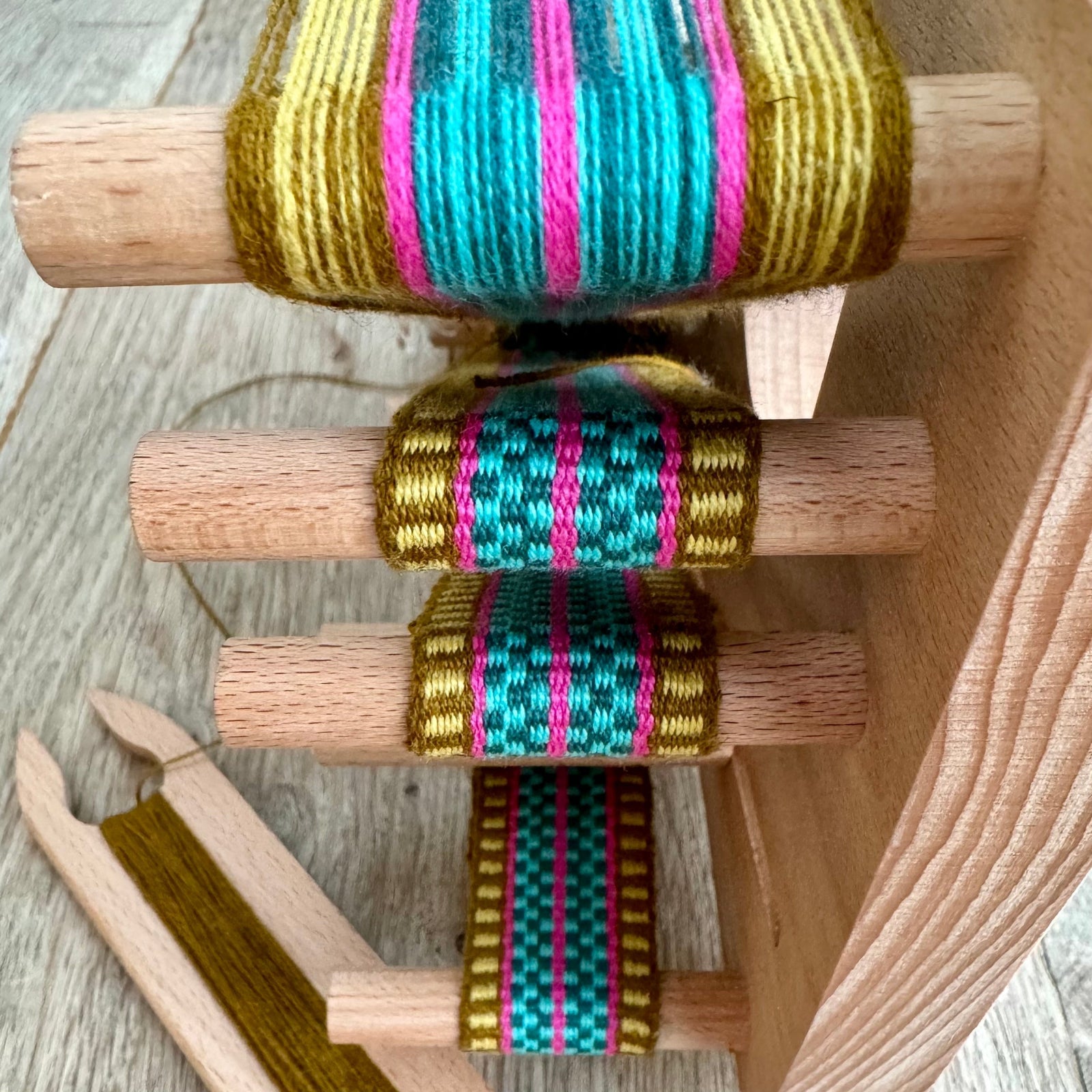
Inkle weaving uses a small standing or table loom that holds the warp under tension via a series of pegs, with a shed created by alternating heddled and non-heddled threads. It's a fixed, portable setup, ideal for warp-faced bands, straps and trims.
Backstrap weaving achieves the same warp-faced structure, but without a rigid loom frame. The warp is tensioned between a fixed point (a hook, post or tree) and a strap around the weaver's own waist, so the weaver's body becomes part of the tensioning mechanism. It's the most portable of the three, since it packs down to almost nothing, but it takes more practice to get consistent tension.
Tablet weaving (also called card weaving) uses small perforated cards or tablets threaded with warp, which are turned to create the shed. This allows for more complex, often diagonal or twill-like patterning than a simple Inkle band, and tablet weaving can be done on an Inkle loom, a backstrap setup, or a dedicated tablet loom. If you'd like to see this in action, this video demonstrates tablet weaving on an Inkle loom, worth a watch if you're curious how the two crossover, though we haven't watched it in full ourselves.
In practice, many weavers move between all three. The same warp-faced principles apply, and the loom or setup you choose often comes down to portability, the complexity of pattern you want, and what equipment you already have.
A few looms that have come up in workshops
Students have shared these finds over various workshops, useful options if you're looking for something specific:
-
Extra long warp: the Dales Looms table-top Inkle loom. Worth noting, their listing advises against floor standing versions, calling them awkward and tedious to set up. Having woven on my own floor standing Inkle loom for years, I don't agree, I've found dressing it straightforward and enjoy weaving on it, sitting at a stool. I haven't used one of the Dales looms though, so can't compare the two directly.
[IMAGE PLACEHOLDER: your own floor standing Inkle loom, a clearer photo showing the full frame]
-
Left-handed option: the Lojan Inkeltje Inkle loom from George Weil, one of the few looms designed with left-handed weavers in mind, this comes up often in workshops.
-
Folding loom: this folding tablet loom on Etsy, useful if storage or travel space is tight.
-
Portable, tablet or heddle: this portable band loom works for both tablet and heddle weaving, a flexible option if you want to try both techniques on one loom. A similar version has come up in workshops too, with a small built-in drawer for tools and materials, though we haven't been able to track down where that particular one is sold.
-
DIY option: if you fancy building your own, Noreen Crone-Findlay's upcycled box loom is a lovely example, made from reclaimed wooden drawers with a hand-built ratchet and pawl mechanism. She's also filmed a YouTube tutorial showing the full build.
Our own Inkle looms
We stock two Ashford Inkle looms in the shop, both in beech hardwood:
[IMAGE PLACEHOLDER: product shot or student photo showing both looms side by side, for scale comparison]
The Inklette is the smaller of the two, compact and light at 530g, with a generous 1.8m (72") weaving length. A cutout in the frame doubles as both a weaving window and a carrying handle, which makes it a popular choice for workshops and guild meetings where portability matters.
The Inkle is the larger, full-size version, with a 3.4m (11') warp length and 100mm (4") weaving width. Still portable enough for a class or workshop, but with more warp to work with before you need to rethread.
[IMAGE PLACEHOLDER: a collage of students' finished Inkle bands from workshops]
Learn to weave with us
If you'd like to try Inkle weaving in person, join us for one of our Inkle Weaving workshops. It's one of our most popular workshops, and it's easy to see why once you've had a go!