

Sonia Delaunay: The Avant-Garde Queen of Colour

Sonia Delaunay wearing Casa Sonia creations, Madrid, c.1918–20
I wanted to write about Sonia Delaunay as there is so much we can learn from her work. Sonia was not an artist I encountered in my studies. I first discovered her at the Tate retrospective of her work in 2015. I was struck by her bold use of colour and the breadth and diversity of her work. Sonia’s work teaches us not to be afraid of colour, but to embrace contrasts and dissonance, to notice the energy and emotion it brings. Just as importantly, she brought art out of the gallery and into our everyday lives, in the clothes we wear and the objects we surround ourselves with. I think we should all be a little more Sonia in our everyday lives, immersing ourselves in colour..
Sonia Delaunay (1885 -1979) was a dreamer, an artist who brought art away from the canvas and into the ordinary world. She was a pioneer of abstraction and a key figure in the modern art movement of early twentieth-century Paris.
She believed deeply in colour: in its power, its energy and the language it could speak. She wanted to take these ideas from the elite world of galleries and modern art and bring them into everyday life. In the 1960s she became one of the first women to have a retrospective at the Louvre, a recognition of her place as a major figure in twentieth-century art.
Sonia Delaunay was born Sara Stern into a modest Jewish family in Gradizhsk, Ukraine.
At the age of seven she was sent to live with her wealthy aunt and uncle in St Petersburg.
It was here that she took her aunt and uncle’s surname, Terk, and became Sofia Terk, though she was always known as Sonia. She found herself in the middle of a prosperous, cultured household. She was introduced to the cultures of both Russia and Europe, developing a curious and searching mind. She read philosophy and poetry, looked at art and spent time considering the ideas she encountered. From an early age she understood that she wanted to live a bigger, more artistic life. She imagined herself living in Paris or London and felt that the respectable middle-class world of St Petersburg would ultimately be too restricting for her.
In 1904 she travelled to Germany to study painting under Professor Schmid-Reutte at the Academy of Fine Arts in Karlsruhe. She found the teaching there limiting and wanted more freedom to express herself. In 1906 she moved to Paris to study at the Académie de La Palette.

Sonia Delaunay, Philomene, 1907
Sonia immersed herself in the avant-garde world of Paris, inspired by artists such as Gauguin, Van Gogh, Renoir and Cézanne. She exhibited with Picasso and Braque and was friends with Kandinsky and Chagall. The Fauvists’ fearless use of colour and the Cubists’ rejection of form and traditional perspective shaped her early painting and became important foundations for the more abstract language she would go on to develop with her future husband Robert Delaunay.
In 1908 she held her first solo exhibition. By then, Sonia had firmly established herself within this new artistic world and had no intention of giving it up. Under pressure from her family to return to St Petersburg, she married Wilhelm Uhde, a German art critic and dealer. It was a marriage of convenience rather than love: Uhde was gay, and Sonia was free to remain in Paris.
It was through Uhde’s gallery and circle that Sonia met Robert Delaunay. The two fell in love, and the following year Sonia divorced Uhde and married Robert.
The Delaunays’ home soon became a meeting place for the literary and artistic avant-garde of Paris. Writers, poets and artists gathered there, exchanging ideas and discussing the rapidly changing world of Modern art.
Sonia and Robert shared the same ideals with a common fascination for colour, movement and abstraction. Sonia described herself as a dreamer, while Robert was the theorist. She was driven by an intense desire to express herself through making, while Robert, she said, taught her the discipline to develop her work. They worked closely together, developing their ideas side by side, and throughout their lives acknowledged the importance of one another’s work.
In 1912, Robert and Sonia began to develop and promote their ideas of Simultanism. Their thinking drew on Michel-Eugène Chevreul’s 1839 book The Principles of Harmony and Contrast of Colours, as well as the work of Impressionist and Neo-Impressionist painters such as Seurat and Pissarro. Robert published explanatory texts setting out the theory, while both artists explored Simultanism through their work.
The couple hosted soirées at their home for the leading figures of the Parisian avant-garde. Paintings were exhibited, ideas were discussed and Sonia appeared in her striking Simultaneous dresses. Simultanism was not simply a theory to be written about, it was to be lived.

Sonia Delaunay, Simultaneous Dress, 1913
At the heart of it was the belief that colour has a life and energy of its own. Colour speaks. Colour can make poetry just as words can.
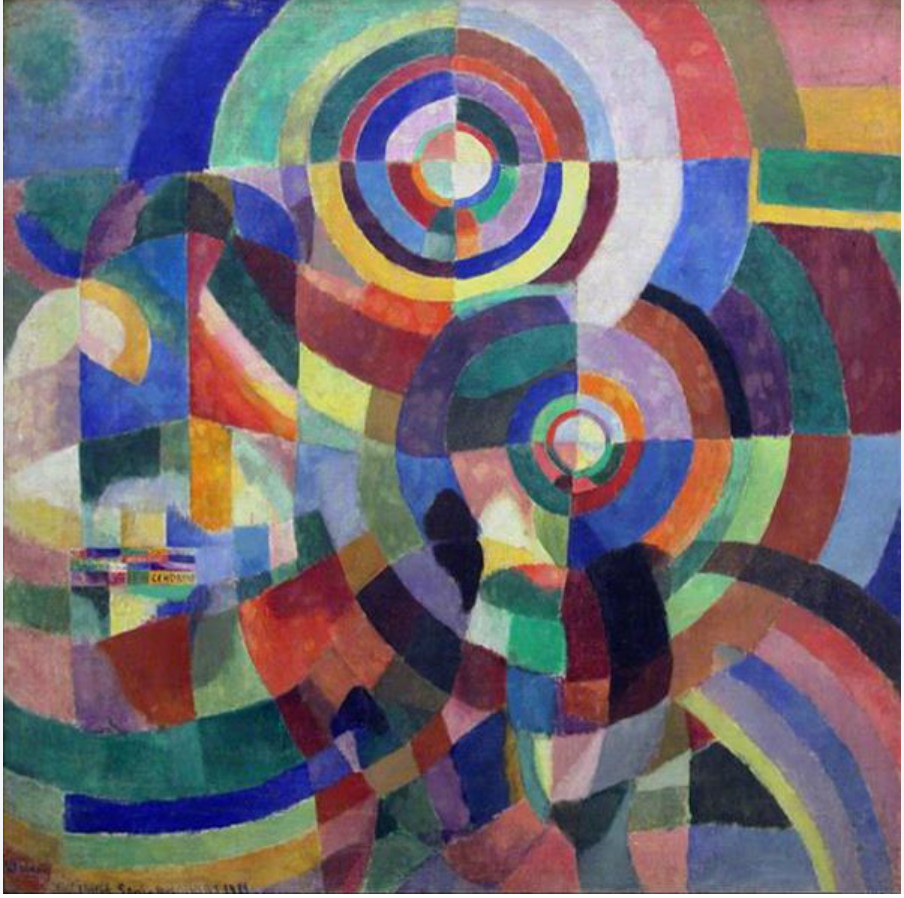
In Michel-Eugène Chevreul’s 1839 text, he observes that we never experience a colour entirely in isolation. The colours placed beside it alter the way we perceive it, complementary colours can intensify one another, while other combinations can create harmony, tension or dissonance. Sonia and Robert took these ideas further, believing that relationships between colours could create their own rhythms, movement and emotion. By understanding how colours behaved together, they began to develop an entirely new visual language.
In painting, Simultanism drew on Cubism, but took it in a very different direction. Whilst Picasso and Braque had stripped their Cubist paintings back to a palette of muted browns and greys, Robert and Sonia embraced colour with increasing intensity. They experimented with overlapping and interlocking patches of contrasting and complementary colour, using them to create rhythm, movement and depth.

Sonia Delaunay, Electric Prisms, 1914. Oil on canvas, Centre Pompidou, Paris
Colour was central to their development of abstract art. For Sonia, that progression soon took her beyond painting.
In 1911, Sonia began to move away from painting solely on canvas and into new mediums. One of the key objects she created at this time was a patchwork bedcover made for her son Charles’s cradle. The patchwork blanket brought together many of the ideas she was already exploring in painting: blocks of colour, contrast, rhythm and abstraction.
Following her marriage to Robert, Sonia’s work expanded from painting into the decorative arts. Some scholars have interpreted this move as a conscious shift towards a more traditionally ‘feminised’ art form, in contrast to Robert’s continued work in painting, which was regarded as a more masculine and prestigious medium.
Sonia herself described the move in much more practical terms. The decorative arts offered a way to earn a living, which at times became a necessity. When a fabric designer in Lyon commissioned her to produce fifty textile designs, she took the commission and approached the designs as a series of colour studies. This shift came naturally to Sonia having studied needlework whilst in Germany. Working in the decorative arts also connected Sonia to a wider idea shared by the Arts and Crafts movement and many avant-garde groups, particularly those emerging from her native Russia: that art should move beyond painting and become part of everyday life. Sonia was not moving away from painting so much as allowing her ideas about colour and abstraction to move out into the world.
Sonia carried the language of Simultanism into an extraordinary range of forms. Her signature patchwork colours appeared across dresses and shoes, book covers and cushions, lampshades and interiors, theatre sets and costumes, and even a car. In her hands, Simultanism moved far beyond the confines of fine art and into the wider world of everyday objects and experiences.

Sonia Delaunay (right) with a model wearing her geometric designs in front of her 1925 painting Simultaneous Dresses, Paris, 1926. Photo by Germaine Krull / Galerie Roger-Viollet
Her Simultaneous dresses expressed this idea especially beautifully. The colours moved with the body, shifting and changing as the wearer walked or danced. Robert described them as a kind of “living painting”, made and remade by the wearer over time.
During the First World War, Sonia and Robert lived between Spain and Portugal. Their circumstances changed dramatically following the October Revolution of 1917. Sonia had inherited property in St Petersburg from her aunt and uncle, and the couple had relied in part on the rental income. When the property was seized after the Revolution, that income disappeared, leaving them in serious financial difficulty.
In 1918 she opened Casa Sonia in Madrid, an interior decoration and fashion shop where Simultanism came alive. She produced costumes for the Ballets Russes, worked on theatre interiors in Madrid and turned her hand to every aspect of interior decoration.

Sonia Delaunay, Costume Design for Cleopatra, 1918. The Metropolitan Museum of Art, New York
In 1921, the Delaunays returned to France, and in 1925 Sonia opened her own fashion house in Paris. By then, her abstract language of colour was being worn, lived with and experienced far beyond the gallery.
In 1941, Robert died and Sonia spent much of the following decades championing his work and helping to catalogue and preserve the work they had made during their long creative partnership. She continued to work and exhibit. She resumed painting, but the colours were now more muted and less free-wheeling. In 1964, she became the first living female artist to be given a retrospective at the Louvre, firmly establishing her own place among the major figures of twentieth-century Modernism.
Sonia died in 1979 leaving behind an extraordinary legacy of paintings, textiles, clothes and objects. However, as the canon of modern art was established, the legacy of men’s work was prioritised and today we often hear of Robert’s name and role in Modernism first. More than anything, her work encourages us to be curious, to experiment, and to bring a little more colour into ordinary life.
Further reading & listening
-
Lærke Rydal Jørgensen and Tine Colstrup (eds.), Sonia Delaunay, Louisiana Museum of Modern Art, Humlebæk, 2022. https://uk.bookshop.org/a/16524/9788793659537 (affiliate link on bookshop.org)
-
Anne Montfort and Cécile Godefroy (eds.), Sonia Delaunay, Tate Publishing, 2015. Published to accompany the major Sonia Delaunay retrospective at Tate Modern. https://www.worldofbooks.com/en-gb/products/sonia-delaunay-book-anne-montfort-9781849763172?sku=GOR006980000&gad_source=1&gad_campaignid=17415896148&gbraid=0AAAAADZzAIClg2hRwsWntxeCwRvtV5T71&gclid=CjwKCAjwqc_UBhBKEiwAWbl25rzS_xZro4sEplcPCLs4dHrMn_tGURvuQ_kMz165KtoQAVIhsFJ2cBoCqLkQAvD_BwE (not affiliated)
-
Kathleen Jamie, “Sonia Delaunay: the avant-garde queen of loud, wearable art”, The Guardian, 28 March 2015. https://www.theguardian.com/artanddesign/2015/mar/27/sonia-delaunay-avant-garde-queen-art-fashion-vibrant-tate-modern
-
AWARE: Archives of Women Artists, Research and Exhibitions, Great Women of Art, Ep. 12 – Sonia Delaunay, podcast, 28 April 2022. https://awarewomenartists.com/en/podcasts/sonia-delaunay/
Images:
Sonia Delaunay wearing Casa Sonia creations, Madrid, c.1918–20. Anonymous photographer, possibly Zockoll. Source: Museo Thyssen-Bornemisza via Wikimedia Commons. Photograph in the public domain.
Sonia Delaunay, Philomene, 1907. Image source: WikiArt. © Sonia Delaunay / Pracusa S.A. Reproduced for the purposes of criticism and review.
Sonia Delaunay, Electric Prisms, 1914. Oil on canvas. Centre Pompidou, Paris. Image source: WikiArt. © Sonia Delaunay / Pracusa S.A. Reproduced for the purposes of criticism and review.
Sonia Delaunay, Simultaneous Dress, 1913. Image source: WikiArt. © Sonia Delaunay / Pracusa S.A. Reproduced for the purposes of criticism and review.
Sonia Delaunay (right) with a model wearing her geometric designs in front of her 1925 painting Simultaneous Dresses, Paris, 1926. Photo by Germaine Krull / Galerie Roger-Viollet.
Sonia Delaunay, Costume Design for Cleopatra, 1918. Watercolour, gouache, metallic paint and graphite on paper. The Metropolitan Museum of Art, New York, Bequest of William S. Lieberman, 2005. Image source: WikiArt. © Sonia Delaunay / Pracusa S.A. Reproduced for the purposes of criticism and review.