

A Full House at Winchester Cathedral's WILD! Festival
Earlier this month, Mum and I took part in Winchester Cathedral's WILD! Festival of Flowers and Nature, giving a talk called Growing and Creating Colour from Plants.

WILD! ran from the 15th to the 19th of September, and explored floral creations, live botanical art, hands-on workshops and unexpected performances, with themes of biodiversity, wellbeing, sustainability, climate, creativity and hope running through the whole week. It was organised by Bex at the Cathedral, who put together an extraordinary event, and it was a pleasure to be part of it.

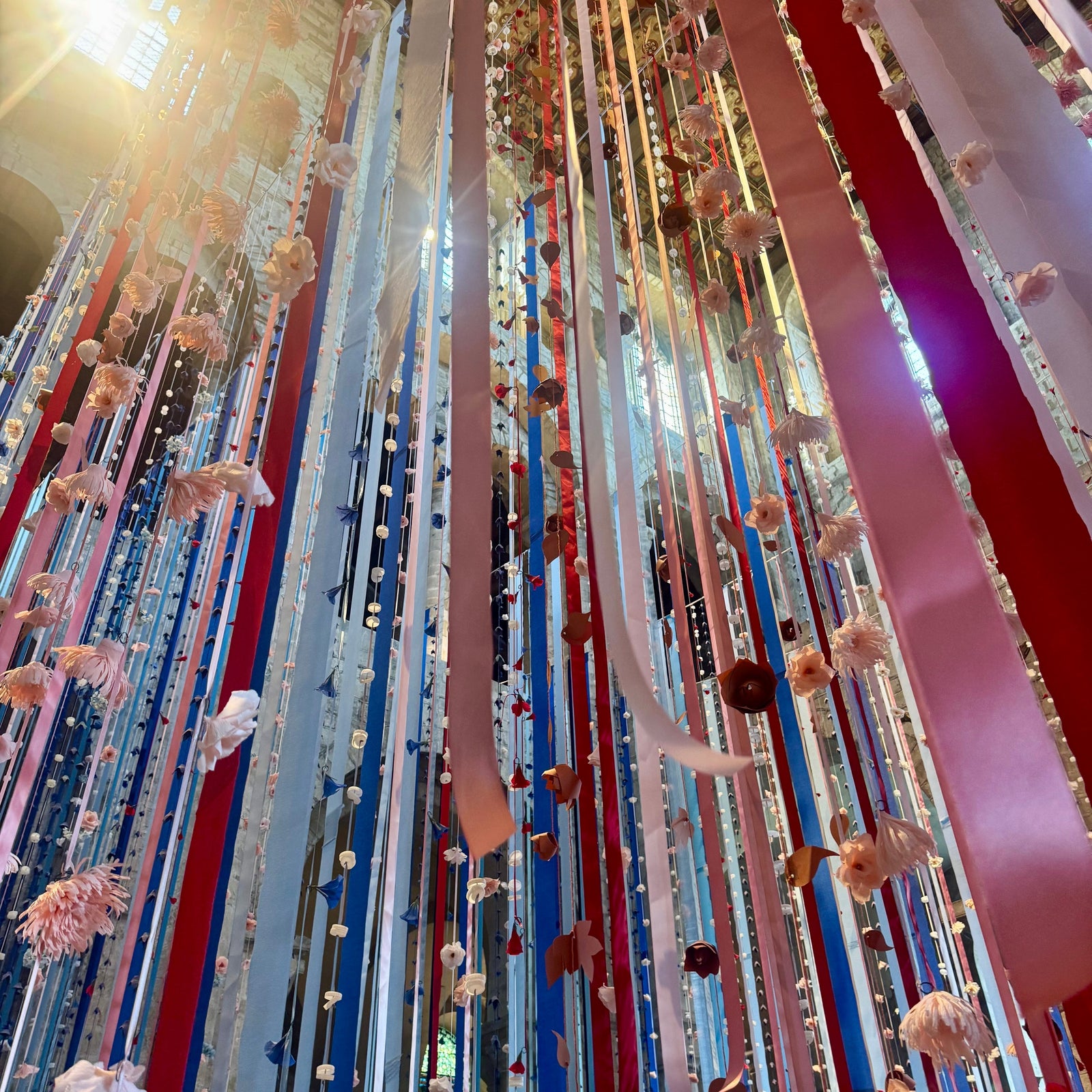
The cathedral itself looked spectacular. One of our favourites was the installation running down the centre of the nave, hundreds of string garlands made from leaves cut from recycled cardboard and little flowers made from recycled egg boxes, alongside flower displays throughout in beautiful autumnal colours.
What we talked about
Our talk was split into two halves. Mum covered the history of natural dyeing, and I covered what you can actually grow yourself.

Mum took the audience right back to the beginning. The oldest known piece of dyed fabric was found at a ceremonial site in Peru in 2009, a scrap of wild cotton over six thousand years old, dyed with indigo. In the same year, archaeologists in the Caucasus Mountains found fossilised strands of wild flax dating back over 30,000 years, some dyed with woad. She talked through the history of the three dye plants that turn up again and again across centuries and continents, madder, weld and woad, including their role in the Bayeux Tapestry and the story of Turkey Red, a vivid, colourfast red dye process so valuable it transformed the textile works of Glasgow in the 18th century. She finished with oak gall ink, a personal favourite of hers, used to write the Magna Carta and still legible centuries later.

I followed with the practical side, what you can actually grow, forage or rescue from the kitchen. Carrot tops, onion skins and avocado skins are all easy places to start, though I flagged that plants like beetroot and red cabbage give vivid but fleeting colour, fun for a quick project but not something that lasts. For anyone wanting to grow their own dye plants, I talked through woad, Japanese indigo, weld, madder and coreopsis, my own favourite, which started life as a reduced pack from Waitrose years ago and has been going strong ever since. Much of what I know came originally from Susan Dye of Nature's Rainbow, who sadly passed away in 2024 and whose generosity with her knowledge lives on through so many gardens and growers.

I also talked about the Kings Somborne School garden project, where coreopsis and marigolds have rather taken over one of the raised beds this year, and how drought resistance is becoming something to think about too, our water tanks ran dry by midsummer this year, though the coreopsis and yarrow both held up without extra watering.
A full house

The talk sold out, 65 people came to listen, which was brilliant. We met former students, some from years ago and some more recent, and lots of people from Winchester Art College. Everyone who came went home with a little packet of coreopsis seeds, grown in the Kings Somborne school garden this year.
 After the talk, Mum and I got to spend time in the natural dye garden the Cathedral and Winchester Art College have created together, tucked away behind the cathedral, talking about sustainability with like-minded people. A properly feel-good day.
Rachel Remnant's talk
One of the talks we were most looking forward to was Rachel Remnant's, on Hampshire's Magnificent Meadows project, which she set up. We spent a lovely evening with her planting wildflower seeds last year, and she's an absolute well of knowledge on the subject.
Huge thanks to Bex and the whole team at Winchester Cathedral for such a well organised, wonderful event, and to everyone who came along to hear us talk, some of you from quite a distance.
If you'd like to learn more about growing your own dye plants or natural dyeing more generally, you can explore our online and in-person workshops at Elka Textiles.