
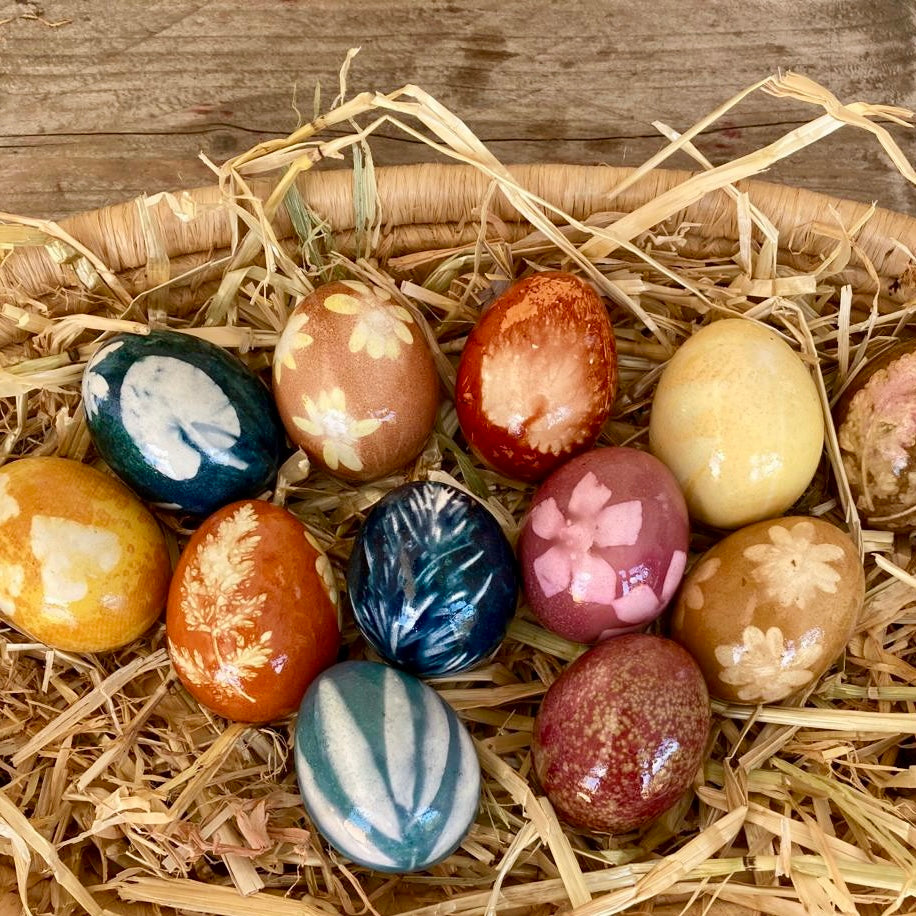

HOW TO DYE EASTER EGGS WITH NATURAL DYES

On my recent natural dyeing workshop someone talked to us about how, as children, she and her friends used natural plant materials to decorate hard-boiled eggs which were then used for a game which involved rolling them down a grassy hillside.
It seems that the tradition of ‘egg-rolling’ takes place in many countries at this time of year to celebrate the spring equinox, when the length of the day is equal to that of the night. It heralds the end of the dark days of winter and the hope of spring and new life. Easter is a Christian festival marking the resurrection of Christ. To pagan Anglo Saxons is was a celebration of Eostra, their goddess of spring and fertility. For every culture the celebration of spring goes back to the days when people’s lives were governed by the rhythms of nature.
A little bit of research told me that most people use natural dyestuffs that can be found in the kitchen: red cabbage, beetroot, onion skins, coffee and turmeric. These are mainly 'fugitive' natural dyes that i wouldn't recommend for dyeing yarns and fibres as the colours fade too quickly, but they're fine for eggs.
Some people simply dye the eggs plain colours and others like to create patterns on the eggs as they’re being dyed. The basic principle for the latter is the same as tie-dying, in that the pattern is created by preventing the dye from colouring certain areas of the egg, ie resist dyeing.
There are several ways of going about naturally dyeing eggs but I did as follows:
- I started by hard-boiling the eggs I planned to dye. I used white eggs which give brighter colours, but brown eggs can be used too for different shades. Put the eggs in a pan of cold water, bring it to the boil and gently simmered them for 10 minutes. Then drain the eggs and run them under cold water to stop them from cooking any further. Set them aside while you prepare the natural dyes.
- Starting with three raw beetroot I grated these into a 20cm / 8inch saucepan, poured in enough cold water to cover them by about 1cm and simmered them gently for 45 minutes. You can just chop the beetroot but I think you get a stronger colour by grating them.

- Allow the cooked beetroot to cool before sieving the deep red dye liquid into a smaller pan or bowl, so you get a sufficient depth of dye to cover the eggs.

- Add a tablespoon of white vinegar per 500ml / 1 pint of liquid. The vinegar reacts with the calcium carbonate of the egg shell and helps the dye to stick. Too much vinegar will create a mottled effect – as you will see from some of my results!
- If you want plain-dyed eggs this is the moment to enter the eggs into the dye and leave them for a few hours to take on the colour, or overnight depending on the shade you want.
- If you feel inspired to create patterned eggs you’ll need:
- Scissors
- String
- Some old tights cut into 15cm / 6 inch lengths
- A collection of flowers, leaves or whatever you want to use to create a resist pattern. A walk round our back garden provided celandines, daisies, periwinkle, nettle, rosemary, ivy and various other leaves and grasses. It’s the shape not the colour that’s important, though the celandines did imprint a little yellow.

- Knot one end of the tights material to create a little bag, place an egg inside, lay the ‘resist’ material on the egg before drawing up the other end of the bag and securing it with string. It can be a bit fiddly trying to keep the ‘resist’ material in place while you tie up the bag, but if you wet the egg and dampen the flowers or leaves etc, it will help to stop them sliding around quite so much.

- As before, place the egg into the dye and leave it for a few hours or overnight. If making several different dyes jam jars, that will hold one or two eggs, are very useful.

- The red cabbage and onion skin dyes were prepared in the same way as the beetroot. The turmeric was mixed well in hot water and left to steep for an hour or so. The coffee was a triple-strong filter brew. White vinegar was added to each dye solution.
No two eggs ever dyed the same colour and some of the mottled effects were unexpected but, I think, are some of the prettiest results. Once the dyed eggs are thoroughly dry, rubbing them with a little oil really brings out the colours. As a guide to the colours:
BEETROOT - pink to dark red
CABBAGE - blue
ONION SKIN - burnt orange
TURMERIC - pale to dark yellow
COFFEE - light brown
It’s not an exact science but it is a lot of fun!
HAPPY EASTER

If you would like to join us on one of our natural dyeing workshops in Wiltshire CLICK HERE.
For more information on our online natural dyeing course, CLICK HERE.