

NATURAL DYEING WITH DANDELIONS

It would be hard not to notice that the dandelion season is here! Although they flower throughout the summer, spring is when they burst forth in profusion. The dandelion (Taraxacum officinale) is a perennial plant that grows widely across temperate zones. As anyone trying to keep them out of their garden will know, they are hard to thwart, each of their fluffy white ‘dandelion clock’ heads containing over a hundred seeds that drift away on a breeze.
 The name ‘dandelion’ comes from the French ‘dent de lion’, lion’s teeth, and the plant has a fossil record going back to the ice ages. Although generally regarded now as a nuisance weed, it has a long history as a medicinal herb. The flowers are used in dandelion wine, the leaves can be added to salads or used to make soup and the roots make a pleasant alternative to coffee. Dandelions are also an important food source for a range of insects.

In addition to all that the dandelion is a natural dye plant – not as bold or as colourfast as weld, but with a subtle charm of its own. The flowers produce a pretty primrose yellow and the leaves a pale green. The roots are of little interest to the natural dyer. Always leave foraged dyestuff outside for an hour or so to give insects a chance to disperse.

I decided to make three dye baths; one with dandelion flower heads, one with the leaves and one with a combination of the two, 50/50. I chose three different fibres to dye: cotton fabric, banana yarn (both plant/cellulose fibres) and woollen yarn (an animal/protein fibre). You cannot dye synthetic fibres with natural dyes, so always use 100% natural fibre.

For each dye bath I used 200% weight of fibre (WOF). So that was twice as much dyestuff as fibre to be dyed. As I was dyeing 25g of fibre in the first dye bath, I used 50g of dyestuff. Be sure to weigh the fibre while it’s still dry, before soaking it thoroughly (wetting-out).
Animal (protein) fibres are generally more fragile than plant (cellulose) fibres and need to be handled with care, so it’s better to dye the animal and plant fibres separately.
All the fibres had been ‘scoured’, (well washed) and then ‘mordanted’. There is no natural affinity between fibres and natural dyes so a mordant is needed to create a bridge between the two. In the case of plant fibres a pre-mordant of tannin is also required. For full details on preparing fibres for natural dyeing see www.elkatextiles.co.uk
PREPARING THE DYE BATHS
NB: do not use your kitchen equipment for dyeing. It’s important to use pots, pans, tongs, sieves, cloths etc. that are kept only for dyeing..
Each dye bath was prepared in the same way:
- Weigh out the dyestuff and add it to the dye pot.

- Cover with enough cold water to allow the dyestuff to move freely.
- Heat to a gentle simmer. This is definitely not a rolling boil! As soon as little bubbles begin to come to the surface, reduce the heat. If you have a thermometer then heat to 80C.

- Hold at around this heat for an hour.
- Remove from the heat and allow the dyestuff to cool in the pot.
- Once the dye pot is cold, strain the contents through a muslin-lined sieve.

- Rinse out the dye pot to make sure it’s free of debris before returning the strained liquid to the pot. This is now your dye bath.

DYEING THE PLANT FIBRES : cotton fabric and banana yarn
- Add the well ‘wetted-out’ plant fibres to the dye bath and heat it to 80C, holding it at heat for an hour. Make sure there is enough solution in the pot to allow the fibres to move freely. If necessary add a little more water.
“Bear in mind that it is not the amount of water used in the dyebath that affects the strength of the dye bath. The amount of water does not ‘dilute’ the dye color. The strength of the dye bath is only affected by the amount of fibre added in relation to the amount of dye color present, as it is the color particles in the solution that have to be shared among the fibers being dyed.” (Jenny Dean, Wild Color, Octopus Publishing Group Ltd, 2010)
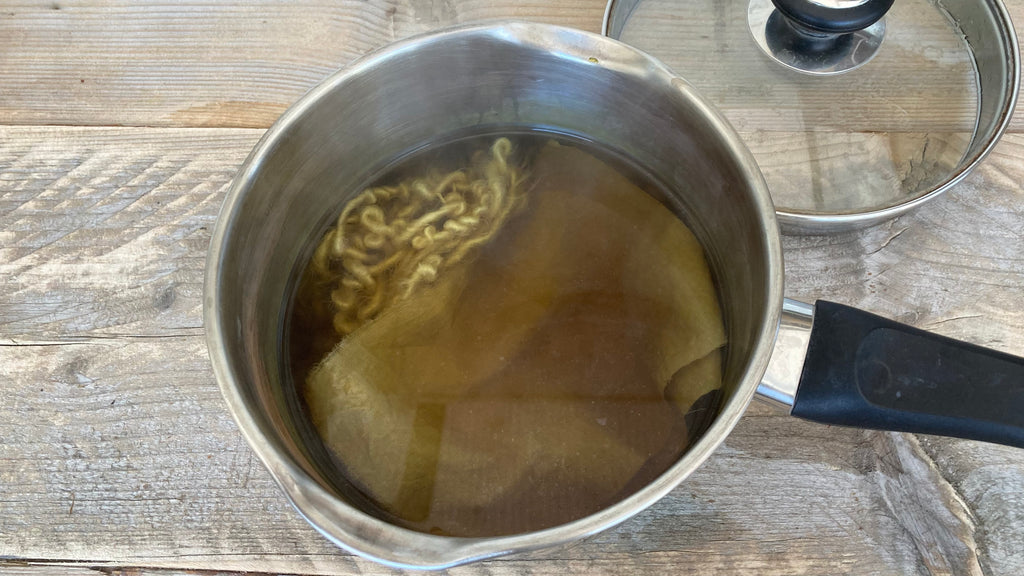
- Allow the dye bath to cool before removing the fibre, which should be hung to dry before washing to avoid losing too much colour.

- Once dry the fibre can then be gently washed in tepid (30C) water using a pH neutral washing liquid, such as EcoZero.

DYEING THE ANIMAL FIBRE : woollen yarn
Dyeing wool and other animal fibres is done in much the same way as dyeing plant fibres but bearing in mind that:
- It’s important to heat the dye bath very slowly to avoid damaging the more delicate protein fibres.
- It’s also important to handle wool very gently as it’s fragile when wet and will matt if agitated too much.
- Wool needs to be heated to minimum 80C in order to open the outer ‘scales’ of the wool to allow the dye to enter the inner cortex of the fibre.
RESULTS OF THE THREE DYE BATHS 
In the dandelion flower dye bath the wool has dyed to a pretty primrose yellow. The banana yarn is almost golden and the cotton fabric has dyed to a warm yellow.
In the dye bath of dandelion leaves, and in the combined flower and leaf dye bath, the most noticeable change in colour can be seen in the plant fibres; the cotton fabric and the banana yarn, which have dyed to a soft olive green.
MODIFYING WITH IRON

NB: keep a separate pot for use only with iron
To extend the colour range of a dye bath, fibres can be ‘modified’ by adding a pinch of iron (ferrous sulphate) to a litre of cold water and soaking the fibres in this solution until a colour change occurs – often very quickly. The fibres can be removed as soon as they take on the colour you want and must then be well washed. An iron modifier will increase the colourfast quality of natural dyes but wool should not be immersed for too long, to avoid damage.
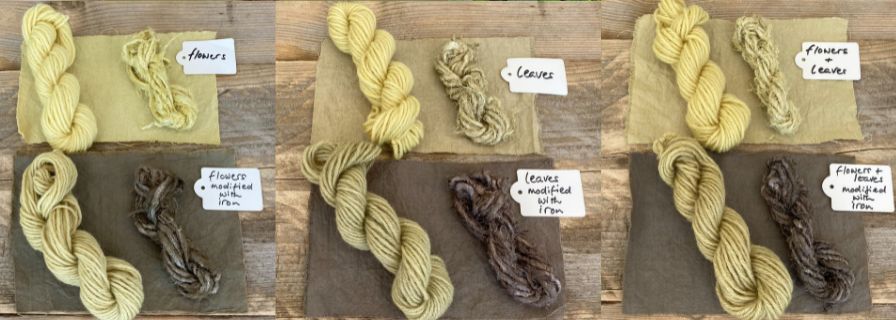
The wool is now a pretty olive green and the plant fibres have turned a rich chocolate brown.
100% , 200% or 400% WOF?

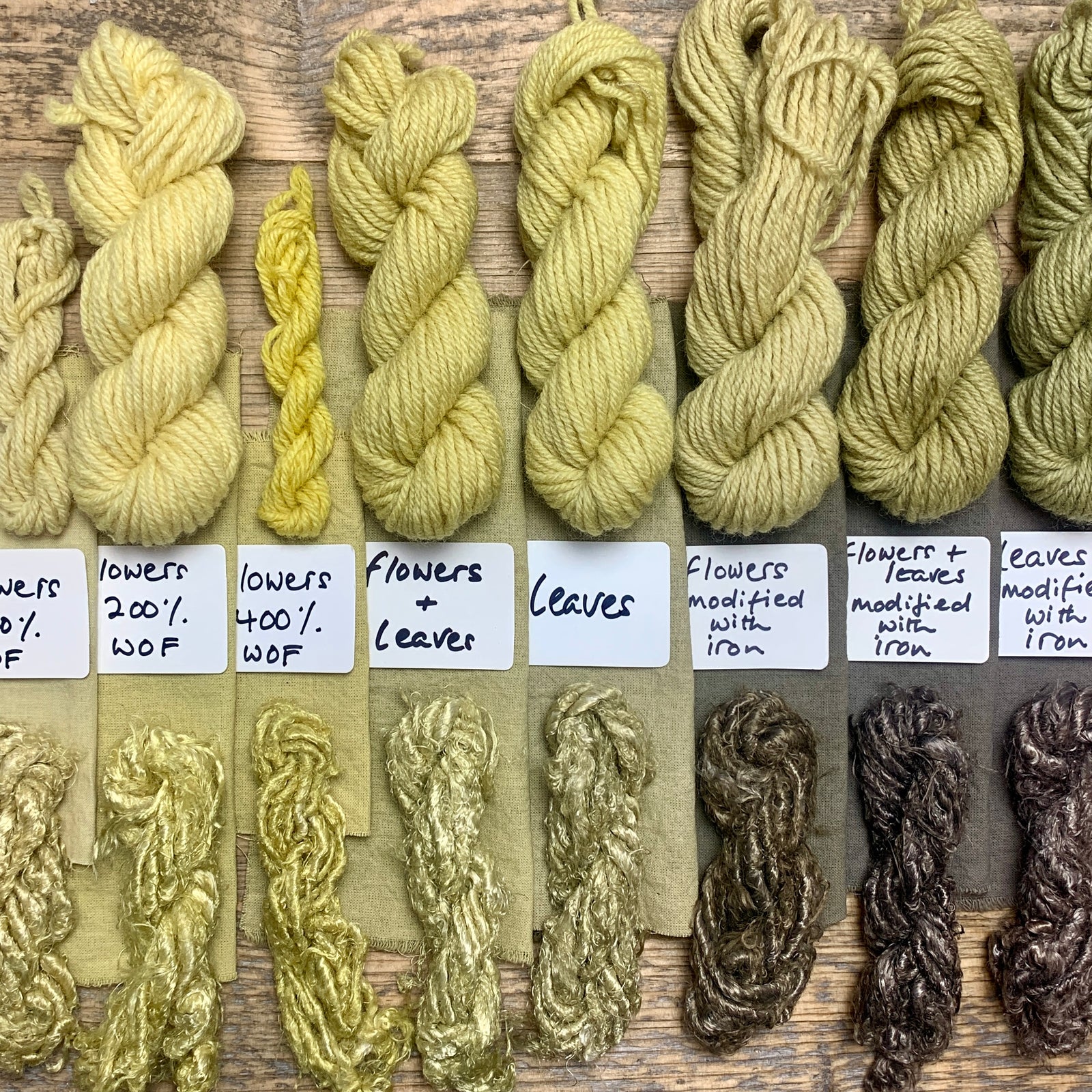
There is a limit to how much dye any fibre will absorb, but as I had left-over dandelion flowers I thought it would be interesting to try a stronger flower dye bath using 400% WOF. This produced a strikingly different result on the wool, which emerged a strong buttercup yellow. There was less change on the two plant fibres.
So what would happen if I used less than 200% dyestuff? As the image shows, at only 100% WOF the result is significantly paler on all three fibres.
TAKE AWAYS:
- If you’re dyeing wool, then increasing the WOF will give a stronger colour.
- The iron modifier has a more dramatic effect on the plant fibres than the wool.
- Washing the fibres did not seem to make much difference to the final colour, suggesting that dandelion dye is relatively washfast..
- At 200% WOF dandelion flowers, leaves, or a mix of both, give a lovely range of colours on both plant and animal fibre.
…… not bad for a humble weed !
If you'd like to join us on one of our natural dyeing courses, either in-person or online you can find out more HERE.